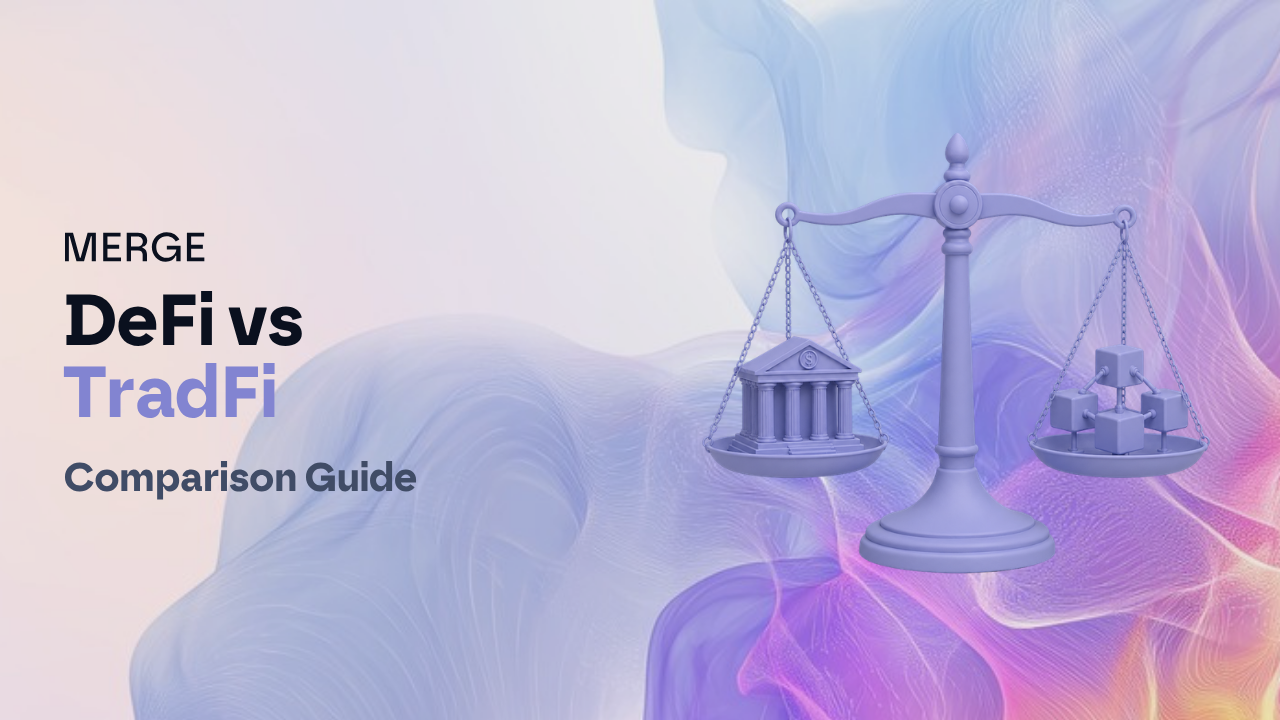

Traditional finance (TradFi) runs on licensed intermediaries such as banks, brokers, and clearing houses supervised by central authorities, while decentralized finance (DeFi) uses smart contracts on public blockchains to execute transactions automatically, with no intermediary holding your assets. The comparison matters now because regulators are formalising the digital side: in the EU, the MiCA Regulation has applied to crypto-asset service providers since 30 December 2024. That said, MiCA targets centralised providers, and the treatment of fully decentralised protocols remains an open question.
This article explains both systems in plain language, compares them across control, access, transparency, and settlement, weighs the pros and cons of each, walks through real-world use cases side by side, and points to where to start learning safely.
In 30 seconds
- TradFi. Regulated banks, brokers and clearing houses: stability, insurance and legal recourse.
- DeFi. Smart contracts on public blockchains: open access, self-custody and 24/7 settlement.
- The size. About $83 billion locked in DeFi in November 2026, versus trillions in TradFi.
- Where it is heading. They converge rather than compete: banks and asset managers already use DeFi in the back end, with KYC and tokenized collateral.
1. What Is Traditional Finance (TradFi)?
Traditional finance is the established, institution-led financial system governed by central authorities and regulators. It is the world of retail banking, stock exchanges, mortgage lending, and pension funds, and it still holds the overwhelming majority of global financial assets.
Key features:
- Centralised intermediaries: banks, brokerages, and insurance companies hold and move money on clients' behalf.
- Regulatory oversight: supervisors such as the SEC, the FCA, and national central banks set and enforce the rules.
- Identity requirements: know-your-customer (KYC) and anti-money-laundering (AML) checks are mandatory before access is granted.
- Fiat settlement: payments and securities clear through established clearing houses and settlement systems.
TradFi is deeply entrenched: trillions in assets, global infrastructure built over centuries, and the trust of billions of users. Its strength is precisely its maturity.
2. What Is Decentralized Finance (DeFi)?
DeFi is an open, permissionless financial ecosystem built on public blockchains, primarily Ethereum. Instead of a bank processing a loan or a broker matching a trade, code does the work.
Key features:
- Smart contracts replace intermediaries: self-executing code enforces the rules automatically, without a firm in the middle.
- Non-custodial: users hold their own assets in a crypto wallet rather than depositing them with an institution.
- Transparent: transactions are recorded on-chain and are publicly auditable by anyone.
- Composable: protocols interlock like financial "Lego" bricks, so one application can build directly on another.
Examples of DeFi protocols include decentralised exchanges (DEXs), lending platforms, yield strategies, and stablecoins. Aave and Compound are DeFi lending protocols on Ethereum, using smart contracts to automate loans and yields, with Aave launching in 2020 and Compound in 2018.
DeFi by the numbers, November 2026
DefiLlama data as of 4 November 2026.
A nuance many beginners miss: DeFi is not the same as CeFi (centralised finance). A centralised crypto exchange holds user assets on their behalf, closer to a bank model, whereas DeFi is non-custodial throughout.
Watch out for CeFi: a centralized exchange holds your assets like a bank, without a bank's protections. Celsius, BlockFi and FTX were CeFi, not DeFi.
How money moves in TradFi and in DeFi
3. Core Differences: DeFi vs TradFi at a Glance
The two systems diverge on four dimensions that shape everyday experience.
| TradFi | DeFi | |
|---|---|---|
| Who controls | Banks and brokers hold your assets | You, through self-custody; code sets the rules |
| Access | Documents, credit history and residency | A wallet and an internet connection |
| Transparency | Internal ledgers and regulated disclosure | Everything on-chain and auditable; pseudonymous identities |
| Settlement | T+1 in the US; T+2 in the EU until 11 October 2027 | In seconds or minutes, 24/7/365 |
| Protection | Deposit insurance and complaints | None: lose your keys and you lose your funds |
| Credit | Based on identity and history | Collateral only, above the amount borrowed |
TradFi vs DeFi, point by point
Control and Intermediaries
In TradFi, banks and brokers hold and control assets on users' behalf. In DeFi, smart contracts govern the rules and users retain self-custody. Aave, for example, allows crypto lending and borrowing without the use of a central authority.
Access and Inclusion
TradFi requires documentation, credit history, and geographic eligibility. DeFi is permissionless: anyone with an internet connection and a wallet can interact with a protocol. On public, permissionless protocols such as Aave, Compound and Sky there is no credit check, so loans are overcollateralised.
Transparency vs. Privacy
TradFi relies on opaque internal ledgers combined with regulated disclosures. DeFi exposes all transaction data on-chain while identities remain pseudonymous, a very different privacy and auditability trade-off.
Speed and Settlement
TradFi typically settles on a T+1 or T+2 basis and operates within banking hours. DeFi settles on-chain in seconds or minutes, 24 hours a day. In Europe, securities settlement moves to T+1 on 11 October 2027.
4. Pros and Cons of DeFi
Pros of DeFi
- Permissionless access: no gatekeepers; anyone globally can participate.
- User custody: you control your assets and avoid third-party insolvency risk.
- Composability: protocols stack together to create innovative financial products.
- Yield opportunities: crypto lending, liquidity provision, and staking can outpace traditional savings rates, though returns vary and carry risk.
- Transparency: auditable code and on-chain data reduce hidden fees and conflicts of interest.
Cons of DeFi
- Smart contract risk: bugs or exploits in code can lead to loss of funds.
- Volatility: underlying crypto-assets fluctuate sharply and can lose value, and collateral can liquidate rapidly. Due to crypto's high volatility, over-collateralization greatly reduces the risk that the protocol cannot repay depositors if collateral values drop, though it does not remove it: if liquidations or oracles fail, bad debt can remain.
- Complexity: a steep learning curve covering wallets, gas fees, seed phrases, and protocol mechanics.
- No consumer protection: no deposit insurance, no dispute resolution, and no recourse if funds are lost.
- Regulatory uncertainty: evolving rules could reshape how protocols operate.
Because crypto-asset values can fall as well as rise, review the risk notice before acting on anything in this section.
5. Pros and Cons of TradFi
Pros of TradFi
- Stability and familiarity: mature, well-understood systems trusted by billions.
- Regulatory protection: depositor insurance, investor protections, and legal recourse.
- Dispute resolution: chargebacks, fraud protection, and human customer support.
- Credit infrastructure: established systems for mortgages, business loans, and credit scoring, built on identity and credit history rather than collateral alone.
Cons of TradFi
- Gatekeeping: billions remain unbanked or underserved because of documentation and credit barriers.
- Slow settlement: multi-day clearing, particularly for cross-border payments.
- High fees: intermediaries take margin at each stage through wire fees, FX spreads, and fund management charges.
- Limited global access: services are fragmented across jurisdictions.
- Opacity: internal ledgers are inaccessible to customers, and conflicts of interest can be hidden.
MERGE Institute
Learn crypto and digital assets from the leaders of the ecosystem
A 12-week programme, taught in Spanish by working professionals from banking, fintech and Web3.
Try a free class →











6. Real-World Use Cases: DeFi vs TradFi Compared
The clearest way to understand the gap is to run the same financial activity through both systems.
Lending and Borrowing
In TradFi, a bank loan involves credit checks and days or weeks of approval. In DeFi, lending is over-collateralised and granted in seconds. Aave's lending and borrowing use pooled liquidity and over collateralized loans managed entirely by smart contracts, not peer-to-peer matching or credit checks. The scale is already significant: DeFi lending protocols held about $51B in deposits per DefiLlama in November 2026.
- 1You deposit collateralFor example, $100 in ETH on a protocol like Aave.
- 2You borrowUp to a share of the collateral (LTV), for example $70 in USDC.
- 3The price dropsAn oracle updates the ETH price in real time.
- 4The threshold is crossedIf the debt exceeds the liquidation threshold (80-85%), your position is exposed.
- 5You get liquidatedA bot repays part of the debt, takes your collateral with a 5-10% bonus, and nobody warns you.
In DeFi you are your own margin call: no account manager rings you. At a bank the initial LTV is around 50% and the threshold 75%; on Aave or Compound you can borrow up to 70% and be liquidated from 80-85%.
How a DeFi loan works, step by step
Payments and Transfers
TradFi cross-border transfers move through correspondent-banking rails that are often costly and slow. DeFi stablecoin transfers can settle in seconds for a fraction of the cost, globally and around the clock.
Investing and Trading
TradFi trading runs through exchanges with opening hours, brokers, and clearing fees. DEXs let users trade tokens 24/7 while holding their own assets throughout.
Savings and Yield
Many TradFi savings accounts pay near-zero interest. DeFi liquidity pools and yield protocols can offer higher but variable and higher-risk returns, with no insurance behind them.
7. The Future of Finance: Convergence or Competition?
The binary is not permanent. CeFi already acts as a bridge between the two worlds, and institutional adoption is accelerating: major banks and asset managers are exploring on-chain settlement, tokenised assets, and blockchain finance infrastructure. The research signal is telling. The Bank for International Settlements discussed agents' motivations to engage in DeFi borrowing and lending activity, using granular transaction-level data from the Aave V2 protocol.
Pure DeFi
Open and permissionless
- Anyone can use it
- Self-custody
- Pseudonymous
- Smart contract risk
- No legal recourse
HyFi (hybrid)
DeFi in the back end, a regulated entity in front
- KYC and access lists
- Tokenized collateral (bonds, funds)
- On-chain settlement
- Complies with MiCA or local rules
- Aave Horizon, Morpho with Coinbase or Société Générale
TradFi
Intermediated and regulated
- Identity-based access
- Bank custody
- Internal ledgers
- T+1 or T+2 settlement
- Deposit insurance
"The back end wins, the front end regulates": DeFi technology does the work and the regulated entity faces the client and the supervisor.
Pure DeFi, HyFi and TradFi: the hybrid model we study at MERGE Institute
Regulation is giving this structure. In Europe, MiCA is sequenced: stablecoin rules under Titles III and IV applied from 30 June 2024, and rules for crypto-asset service providers under Title V applied from 30 December 2024, with a transitional period that ended on 1 July 2026. The likely outcome is hybrid: regulated entities using DeFi rails while TradFi absorbs blockchain efficiencies. How banks approach stablecoins, tokenization, and institutional crypto is exactly what the Tokenization & Capital Markets and Banks, Brokers & Institutional Crypto tracks examine at MERGE Madrid, positioned as Europe's largest crypto and tech event, with 3,000+ attendees, 200+ speakers, and participants from 40+ countries.
Tokenized traditional assets, November 2026
Source: rwa.xyz, 4 November 2026. These assets are already used as collateral in DeFi and on exchanges.
- Aug 2025Aave HorizonLending market with KYC and tokenized bonds as collateral
- Sep 2025Société GénéraleBrings its MiCA stablecoins to Morpho and Uniswap
- Nov 2025JPMorganLaunches its JPMD tokenized deposit on Base, a public network
- Nov 2025BlackRockIts BUIDL fund is accepted as collateral on Binance
- Dec 2025DTCCThe SEC lets it tokenize stocks, ETFs and Treasuries
- Dec 2025UniswapTurns on fee sharing with its token
- Mar 2026NasdaqThe SEC approves its tokenized securities pilot
- Apr 2026SECAnnounces an exemption to trade tokenized securities in DeFi
- Jul 2026MiCAThe transitional period for crypto providers ends
- Sep 2026CLARITY ActThe US Senate blocks the market structure bill
TradFi and DeFi converge: the milestones of 2025 and 2026
8. How to Get Started in DeFi
Start with education before committing any funds. The costliest mistakes in DeFi are almost always beginner mistakes.
Core concepts to master first:
- Setting up and securing a non-custodial wallet, including how seed phrases work.
- Understanding gas fees and how blockchain transactions settle.
- Identifying and evaluating DeFi protocols, including their audits and track record.
- Assessing DeFi risks: smart contract exploits, liquidity risk, oracle risk, and scams.
- Exploring crypto lending and yield strategies cautiously.
Practical first steps: start small, practise on testnets, diversify protocol exposure, and never commit more than you can afford to lose. Because the space moves quickly, structured and reputable Web3 finance education beats piecing knowledge together from scattered sources. MERGE Institute, built with Tritemius, teaches these foundations across 9 modules and 50+ hours, with practitioner instructors from organisations including Banco Santander, Polygon Labs, and Kaleido, and it is a non-university executive certificate program, not an official master's degree.
MERGE Institute
Learn crypto and digital assets from the leaders of the ecosystem
A 12-week programme, taught in Spanish by working professionals from banking, fintech and Web3.
Try a free class →Key Takeaways
- TradFi relies on regulated intermediaries and offers stability, insurance, and legal recourse; DeFi uses smart contracts for permissionless, self-custodied, transparent finance, with no consumer protection.
- The two differ most on control, access, transparency, and settlement speed, with DeFi settling on-chain 24/7 and TradFi on a T+1 or T+2 basis.
- DeFi lending is over-collateralised and credit-check-free, which is why collateral management and volatility risk are central.
- Regulation is formalising the digital side: MiCA's crypto-asset service provider rules have applied since 30 December 2024.
- The realistic future is convergence into hybrid models, which makes understanding both systems the most valuable position for professionals.
To go deeper with a structured, practitioner-led curriculum, explore MERGE Institute.
Frequently Asked Questions (FAQ)
What is the main difference between DeFi and TradFi?
DeFi removes financial intermediaries by using smart contracts on a blockchain, so users interact directly with protocols and keep custody of their assets. TradFi relies on centralised institutions such as banks and brokers to hold assets and facilitate transactions under regulatory supervision.
Is DeFi safer than traditional finance?
Both carry distinct risks. TradFi offers regulatory protection, insurance, and recourse; DeFi offers transparency and self-custody but exposes users to smart contract vulnerabilities and volatility with no consumer recourse. Crypto-asset values fluctuate and can lose value.
What is the difference between DeFi and CeFi?
CeFi (centralised finance) refers to crypto platforms such as exchanges that hold user assets on their behalf, closer to a bank model. DeFi is fully non-custodial: users control assets via wallets and interact directly with protocols.
Can traditional banks use DeFi technology?
Yes. Institutional adoption is growing, with banks and asset managers exploring tokenised securities, on-chain settlement, and permissioned blockchain infrastructure. The Bank for International Settlements has even studied transaction-level DeFi lending data from Aave.
What are the biggest risks in DeFi?
Key risks include smart contract exploits, asset volatility, liquidation risk, oracle manipulation, regulatory uncertainty, and user error such as lost seed phrases or phishing, all without the consumer protection TradFi provides. A manipulated or stale price feed can trigger bad-debt liquidations or under-collateralized borrows.
How can I learn DeFi properly?
Structured Web3 finance education, such as the programs offered by MERGE Institute, helps learners build from foundational blockchain concepts through to advanced DeFi protocols, reducing the risk of costly beginner mistakes. MERGE Institute programs are non-university executive certificate programs.
Conclusion: Choosing Your Financial Future
TradFi offers stability, protection, and familiarity; DeFi offers openness, control, and innovation. Each comes with meaningful trade-offs, and neither is simply "better" than the other. What is increasingly clear is that the two systems are converging rather than only competing, as regulated institutions adopt blockchain rails and on-chain finance absorbs the discipline of regulation.
The most valuable position for individuals and professionals is to understand both well enough to work across them. Whether you are exploring DeFi for personal growth or building a career in Web3 finance, education is the first and most important step, and MERGE Institute offers a structured path to get there.