The Muxic: Tokenizing Music Rights for Artists and Fans
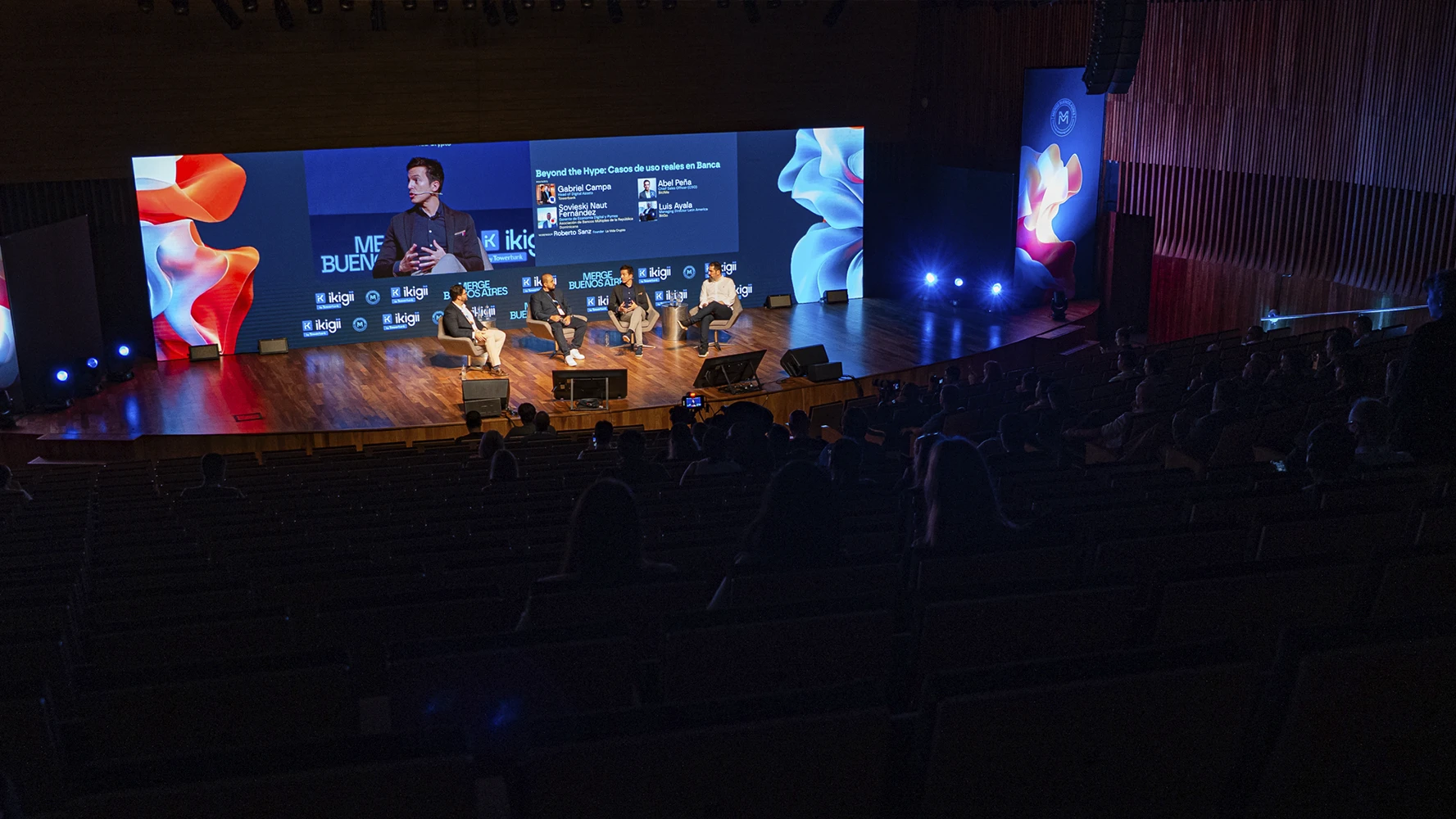
The Muxic presents at MERGE Madrid 2026 its regulated platform for tokenizing music rights: reward-based crowdfunding, issuances using Token City technology, communities of fan investors and international expansion
Date: 29/10/2026
16:50h. - 17:10h.
Place:
MADRID Stage
20min · Full recording from 29/10/2026 at MADRID Stage. Also available on YouTube.
Overview
Can a fan own a share of the music they listen to? In this MERGE Madrid 2026 talk, The Muxic argues that music rights are a digital asset like real estate or private equity, but one where tokenization is still almost non-existent. The company presents its regulated platform, which supports artists from their first crowdfunding campaigns through to issuing part of their rights among their followers.
Tokenizing music rights means converting a song's future royalty stream into blockchain-tracked digital tokens that an artist sells directly to fans or investors, who then receive a pro-rata share of the income. Music rights tokenization is basically taking those music rights, the ownership of future royalty payments, and turning them into digital tokens on a blockchain, so each token represents a stake in the song's future earnings. That said, these tokens usually qualify as regulated securities, secondary markets are thin, and one of the early flagship platforms wound down in 2024, so the mechanics and the law matter before any capital moves.
The royalty infrastructure that pays songwriters and performers has not fundamentally changed in decades, and tokenization is the first structural attempt to rewire it. The background below is useful for three kinds of reader: independent artists looking for upfront funding, fans curious about owning a slice of the music they love, and investors exploring real-world asset tokenization.
Below the session summary, this page also explains what tokenizing music rights means, how fractional micro-share sales work from minting to payout, how the main music tokenization platforms compare, the securities law questions, the economics for artists and fan-investors, the 35-year copyright reversion rule, what happens if a platform shuts down and how royalty token income is taxed.
What you'll learn
- The opportunity: why music is an asset with little correlation to others and barely tokenized
- The artist's problem: low income and difficulty monetizing the future value of their work
- Three models: reward-based crowdfunding, regulated issuance of rights and a future trading venue
- Fan community: how the investor becomes a follower with exclusive benefits
- Technology and regulation: the pillars the platform rests on
- Scalability: the plan to grow in countries with their own regulation
Session summary
An asset still untokenized
The Muxic maintains that music is a large, stable market with little connection to economic cycles, because people keep listening to music whatever happens. While other sectors move ahead with tokenization, in music the share is close to zero, and that is where it sees its opportunity, with a focus on Latin America.
The problem it solves
According to the talk, more than half of artists in Spain do not reach the minimum wage and have no way of monetizing the future value of their rights. Fans, for their part, pay to listen to music but have no real connection with the artist and cannot share in their rights.
Reward-based crowdfunding
In the first model, followers contribute money in exchange for rewards, such as attending a concert or hearing a record before anyone else. These are small campaigns, designed for recording a first release, in which the artist gives up no rights and gains visibility thanks to the platform's reach.
Issuing rights
In the second model, the artist issues, in a regulated way, up to half of their rights, divided into low-value tokens. This brings future income forward to present value, and followers receive their proportional share of the returns. The company plans a third model, a venue where albums and catalogs are traded.
A community around the artist
The investor joins a private community in which the artist offers benefits not available outside it. The platform adds services from partners in ticketing and music distribution to support the artist's career.
Pillars and expansion
The Muxic relies on Token City's technology and explains that it operates within the CNMV framework to place issuances on the primary market. It highlights the social impact of channeling resources to the artist without intermediaries and plans to grow in Latin America and other markets as they adopt regulation.
Learn more about music rights tokenization
Beyond the talk, here is the background you need to understand music rights tokenization.
What does tokenizing music rights actually mean?
The core definition
A song generates royalties every time it is streamed, performed, or licensed. Tokenization treats that income stream as an asset, splits it into blockchain-tracked digital units, and sells those units directly to fans or investors. A platform can divide expected income into, for example, 1,000 tokens, each worth roughly $100 of future earnings; those tokens live on a blockchain, and whoever holds them is entitled to a proportional share of whatever the song actually earns, paid out as it comes in.
This is the key distinction from a collectible: a royalty token represents a contractual, revenue-generating claim, not just a picture. The phrase worth keeping in mind is that music rights tokenization equals fractional ownership of an income-producing intellectual-property asset. For a broader primer, our explainer on what a digital token is sets out the categories.
NFTs vs. fungible tokens, and why the distinction matters
Not all tokens behave the same way. Because NFTs are uniquely identifiable, they differ from cryptocurrencies, which are fungible, and as a result they cannot be copied, substituted, or subdivided. Critically, the ownership of an NFT as defined by the blockchain has no inherent legal meaning and does not necessarily grant copyright, intellectual property rights, or other legal rights over its associated file. That makes a bare NFT a poor instrument for royalty sharing unless a legal contract is explicitly attached.
Fungible tokens (the ERC-20 or BEP-20 style) are identical and divisible, so every token earns the same pro-rata cut, which suits royalty distribution. Hybrid models exist too: Royal's structure combined a royalty right with experiential perks, covered below.
Divisibility
- NFT (non-fungible): One-of-a-kind
- Fungible royalty token: Divisible, identical units
Liquidity
- NFT (non-fungible): Thin, collector-driven
- Fungible royalty token: Potentially deeper, but still limited
Best use case
- NFT (non-fungible): Collector editions, badges
- Fungible royalty token: Pro-rata royalty sharing
Legal right by default
- NFT (non-fungible): None automatically
- Fungible royalty token: Defined by the attached contract
How the blockchain layer works
The engine is a smart contract. A distributor routes streaming income to a wallet; the contract reads the incoming balance, calculates each holder's share, and forwards payment automatically. Because the ledger is public, anyone can verify payment flows without trusting an intermediary. This is a big deal because it makes assets that were once hard to divide, like music rights, into easily manageable digital pieces. The regulated infrastructure layer matters as much as the code: in Spain, in 2025 the CNMV authorized the establishment of Token City Exchange as a securities agency, allowing the company to offer regulated investment services including brokerage, custody, and registration of tokenized assets.
How fractional micro-share sales work: from minting to payout
The artist's decision set
The first choice is which rights to tokenize: master (recording) royalties, publishing and sync rights, or a blend. The second is how much to sell. A conservative range is 10 to 30 percent; keeping the majority preserves control and long-term upside. The third is pricing, which is simple arithmetic: token price multiplied by number of tokens equals the target raise. One thousand tokens at $50 each raises $50,000.
The minting and campaign process
The artist submits royalty documentation; the platform verifies ownership and builds the legal wrapper, often an assignment to a special-purpose vehicle or a direct contract. A smart contract is then deployed specifying total supply, the royalty percentage, payout cadence, and the platform fee. The campaign goes live, fans buy tokens with fiat or crypto, and proceeds minus the fee flow to the artist. Importantly, in the sound version of this model the artist retains creative control, masters, and copyright, and token holders simply receive distributions when royalty income arrives.
Automatic royalty distribution mechanics
Once the song is live, a distributor routes streaming income to the platform wallet, and the contract splits it. A worked illustration: if Spotify pays $1,200 in a period and the tokenized share is 20 percent, the contract sends $240 to token holders and $960 to the artist. The advantage over traditional royalty accounting is an on-chain audit trail rather than a black box. There is a caveat worth stating plainly: the upstream pipeline from streaming platform to distributor to rights holder still introduces a 60-to-90-day delay; the smart contract automates the distribution step, but it does not compress the collection pipeline.
A regulated European model
The Muxic, the company in this session, illustrates a regulated European approach: it works with Token City's technology and operates within the CNMV framework, combining reward-based crowdfunding with the regulated issuance of part of an artist's rights, as summarized above. A related session is available in MERGE's on-stage recording on music tokenization and superfan communities.
Platform-by-platform comparison: where artists can tokenize today
The major platforms at a glance
The landscape is young and uneven. Below are the main platforms, point by point; figures are approximate and discussed in the notes that follow.
The Muxic (Token City)
- Blockchain / region: Spain / EU
- Approx. minimum: Not published
- Model and fee: Regulated rights issuance
- Regulatory status: CNMV framework (securities)
Corite
- Blockchain / region: BNB Chain / global
- Approx. minimum: Varies by campaign
- Model and fee: Crowdfunding + royalty share, ~10% fee
- Regulatory status: Fan-funding, non-registered
anotherblock
- Blockchain / region: Ethereum / EU
- Approx. minimum: ~€99
- Model and fee: Track-level royalty rights
- Regulatory status: EU MiFID II framework
SongVest
- Blockchain / region: US
- Approx. minimum: $100
- Model and fee: SongShares royalty securities
- Regulatory status: SEC Regulation A+ qualified
Opulous
- Blockchain / region: Music DeFi
- Approx. minimum: Varies
- Model and fee: IP-backed lending, MUSE token
- Regulatory status: Low on-chain activity
Royal.io
- Blockchain / region: Ethereum / US
- Approx. minimum: $50
- Model and fee: LDA royalty + perks
- Regulatory status: Wound down from 2024
Royal.io: the LDA perk bundle, and its decline
Royal popularized the concept. Artists could list a song on Royal and decide what portion of their streaming royalties to share, then mint Limited Digital Assets (LDAs), tokens that give holders a share of royalties plus perks like VIP concert access or special merch drops. That bundle made a token attractive even when streaming income was modest. The current-state detail readers need: two of the most-cited platforms in this space no longer exist, and Royal.io sunsetted its marketplace in April 2024 and is no longer accepting new artists. Sources differ on how far the wind-down went. One account notes the project is sunsetting its marketplace but continuing to allow token trades and royalties through OpenSea and the Royal.io site respectively, while a later analysis states that Royal.io, which raised $71 million, shut down in late 2024. The honest reading is that Royal scaled back new offerings under regulatory pressure and is not a live route for new artists.
Corite's promotion flywheel
Corite takes a distinct, crowdfunding-first approach. Corite says it takes a 10% cut of raised capital and future royalties, while artists typically share 15% to 20% of royalties with fans, with the rights reverting back to the artist after one year. The differentiator is the incentive loop: it doesn't just turn fans into passive investors; they're incentivized to actually promote the release, since their token's value depends on the song's success. One of the platform's advisers framed this neatly, describing backers as a digital street team. For music crowdfunding, that converts a marketing-budget problem into a self-reinforcing community.
Emerging and regional platforms
Beyond those two, the field is fragmenting by regulatory regime. SongVest operates under SEC Regulation A+ qualification, issuing fractional music royalty securities called SongShares with a $100 minimum, which gives it legal clarity that Royal.io lacked. In Europe, anotherblock offers fractional streaming-royalty rights with a roughly €99 minimum under an EU MiFID II framework. Opulous pursues a DeFi lending angle backed by music rights, though on-chain activity there has been thin. The visible gap: no dominant, compliant platform yet serves classical, jazz, or non-English-language catalogs. Regulated EU entrants such as The Muxic, which works with Token City's technology, follow a securities-law route instead.
The legal landscape: securities law, the Howey Test, and staying compliant
Why royalty tokens look like securities
In the United States, the governing question is the Howey Test. The four-prong test used to determine whether an investment contract exists is: an investment of money, in a common enterprise, with the expectation of profit, to be derived from the efforts of others. A royalty token checks all four boxes: fans invest money, pool it with others, expect income, and depend on the artist's effort to produce streams. As the SEC's own framing makes clear, the determination turns primarily on the expectation of profit from the efforts of others, since investment of money and common enterprise are easily met. That is exactly why Royal scaled back: many platforms are careful with their wording, often describing tokens as fan collectibles that just happen to come with royalty perks.
Legal structures that manage the risk
If an instrument is a security, it must be registered or fit an exemption. Three US exemptions matter most for music:
- Regulation Crowdfunding (Reg CF): the most accessible route for independent artists. Reg CF allows a company to raise up to $5,000,000 in any rolling 12-month period; the cap was raised from $1.07 million by the SEC's 2021 amendments and remains the limit in 2026.
- Regulation A+ (Tier 2): a larger, costlier "mini-IPO." Reg A+ goes to $75M under Tier 2, but needs SEC qualification, audited accounts, and ongoing reporting.
- Regulation D (506b/c): private placement with no cap at all, but generally limited to accredited investors, which excludes most retail fans.
Some platforms domicile offshore in jurisdictions where tokens are not classified as securities, which trades legal cost for enforcement and investor-protection risk.
International variation: EU MiFID II and MiCA
Europe approaches this differently. MiCA, the EU's crypto-asset regime, has applied since December 2024, but royalty-linked instruments usually sit outside it. As one legal analysis puts it, intellectual-property tokenization is generally not governed by MiCA when the instrument qualifies as a financial instrument, which is the usual case for royalty-linked bonds, participations, or shares, so securities law applies: MiFID II, the Prospectus Regulation and, in Spain, Law 6/2023 with registration through an authorised ERIR under CNMV supervision. In Spain specifically, the regime is developed by Royal Decree 814/2023, the first ERIR was authorised in November 2024, and the CNMV supervises the circuit. The practical takeaway: artists and platforms operating across borders must map each jurisdiction independently. Our guides to MiCA and real-world-asset tokenization go deeper.
A practical compliance checklist
Consult an entertainment attorney with securities experience before minting. Determine the applicable exemption (Reg CF is most common for indie artists in the US). Ensure the platform holds or assists with required filings. And document the ownership chain cleanly, never tokenizing rights you do not fully control. None of this is legal advice; it is a prompt to get qualified advice.
Economics for artists: upfront funding vs. long-term dilution
The upfront capital case
A typical independent artist needs roughly $20,000 to $50,000 to fund recording, mixing, mastering, a video, and launch marketing. The alternatives are poor: bank loans are rarely available, a label advance surrenders far more control, and reward crowdfunding gives no royalty income to backers. Tokenization sits in between. The break-even logic is simple: if an artist raises $50,000 by selling 20 percent of royalties, the deal is only "bad" if that 20 percent later proves to be worth more than $50,000 in present value.
The downside scenario: modeling a breakout hit
This is where artists get hurt. Suppose an artist sells 20 percent of a song for $10,000 upfront, and the song later accumulates 50 million streams. Spotify pays an average of $0.003 to $0.005 per stream in 2026, so at roughly $0.004 those 50 million streams gross about $200,000. The tokenized 20 percent is then worth around $40,000, meaning the $10,000 advance effectively cost the artist $30,000 in foregone royalties. The lesson is that upfront pricing must anticipate upside; selling a smaller slice (10 to 15 percent) reduces, but does not eliminate, the dilution risk.
Structuring a fair deal
Prudent structures cap the royalty percentage sold (under 20 percent is a common ceiling), keep sync, master licensing, and live income outside the tokenized share, and increasingly add sunset clauses so token rights expire after a fixed term rather than in perpetuity. Corite's one-year reversion is a built-in version of this idea.
Economics for fan-investors: realistic return modeling
What does a $50 token actually pay?
Round numbers mislead; real streaming rates are the only honest input. Using a blended rate near Spotify's $0.004, a successful indie track earning 2 million streams a year grosses about $8,000. A holder of one of 1,000 tokens representing a 20 percent royalty share owns 0.02 percent of total royalties, so the annual payout is roughly $8,000 × 0.20 ÷ 1,000 = $1.60 per token. On a $50 token, that is about a 3.2 percent gross yield before platform fees and tax.
Apple Music pays more per stream, which directly answers the common question about a million plays: at $0.007 to $0.01 per stream, 1,000,000 streams is worth roughly $8,000 to $10,000, or, as another 2026 estimate puts it, around $0.008 for most independent artists, roughly $8 per 1,000 streams and $8,000 per 1,000,000 streams before any distributor commission. Spotify, by contrast, pays less for the same milestone: 1 million streams pay about $3,000 to $5,000, as gross figures for the recording before splits.
Sensitivity: streams vs. annual token yield
The figures below model the annual payout per $50 token, assuming 1,000 tokens, a 20 percent royalty share, and a blended $0.004 per stream.
500,000 streams a year
- Gross royalties: $2,000
- 20% to holders: $400
- Per $50 token: $0.40
- Gross yield: 0.8%
1,000,000 streams a year
- Gross royalties: $4,000
- 20% to holders: $800
- Per $50 token: $0.80
- Gross yield: 1.6%
5,000,000 streams a year
- Gross royalties: $20,000
- 20% to holders: $4,000
- Per $50 token: $4.00
- Gross yield: 8%
10,000,000 streams a year
- Gross royalties: $40,000
- 20% to holders: $8,000
- Per $50 token: $8.00
- Gross yield: 16%
50,000,000 streams a year
- Gross royalties: $200,000
- 20% to holders: $40,000
- Per $50 token: $40.00
- Gross yield: 80%
The spread is enormous, which is the point: a modest track pays a few percent, a viral hit pays many multiples, and a flop pays near zero. These are illustrative figures, not forecasts; crypto-linked and royalty-linked assets fluctuate and can lose value.
Non-financial returns: the fan loyalty argument
Streaming yield is not the whole return. Royal's perks (VIP access, merch) carried value independent of payouts, and Corite's design deliberately turns holders into promoters who can raise the very stream count they benefit from. Co-ownership converts passive listeners into active advocates with aligned incentives, which is the real innovation here regardless of whether any single token prints a high yield.
Liquidity risk warning
Be realistic about exit. Secondary markets for royalty tokens are thin, most platforms do not guarantee a buyer, and a token may be impossible to sell before maturity or a platform closure. Fan-investors should treat this as an illiquid, long-duration position, not a tradeable security with a reliable bid.
The 35-year copyright reversion rule and tokenized rights
What the 35-year rule actually says
US copyright law gives creators a second bite at the apple. Section 203 covers grants made on or after January 1, 1978, with termination 35 years after the grant; Section 304 covers pre-1978 copyrights with a later window; and most working indie artists today fall under Section 203. More precisely, Section 203 permits authors to terminate qualifying copyright grants notwithstanding contrary contract language, and the termination becomes effective during a statutory five-year period that generally opens 35 years after the grant was executed. Congress built this in deliberately, because artists often sign their worst deals before a work proves its value. Crucially, the termination right is inalienable under Section 203; it cannot be waived, sold, or contracted away in advance, and any clause purporting to do so is unenforceable.
The collision with token ownership
If an artist tokenizes 20 percent of royalty rights and later exercises Section 203 to reclaim rights from a prior transferee, what happens to token holders? There are two broad scenarios. If the artist tokenized rights they held directly, there is no prior transfer to terminate, so the tokens are unaffected. But if the tokenized royalties flow through a label or publisher deal, and the artist reclaims those rights, the underlying income structure can change, and token holders may find their stream altered or extinguished depending on how the token contract is written. Most published platform terms simply do not address this.
What artists and investors should do
Artists should ensure the rights layer being tokenized is clearly owned and not subject to a prior third-party grant that a future termination could unwind. Investors should read the platform's terms for any Section 203 disclosure; its absence is itself a red flag. Well-drafted Reg CF-compliant offerings typically include representations and warranties on title, and verifying that language is present is basic due diligence.
What happens if the platform shuts down?
Custodial risk vs. smart-contract self-sufficiency
Royal's wind-down made this question concrete. In a custodial model, the platform holds the royalty wallet and pays out through its own systems, so if it fails, the payout mechanism can disappear even when the tokens still exist on-chain. In a self-sufficient model, the royalty wallet is a public, permissionless contract that keeps receiving and distributing funds without the platform. Royal moved in that direction late in its life: in April 2024 it announced it was revamping the platform, shifting away from centralized data storage to store data on-chain and open smart-contract deployments to the public.
Real-world failure modes
Three failure modes matter. In platform insolvency, if the platform is the named royalty recipient with the distributor, holders receive nothing until payment flows are redirected. In token portability, ERC-20 tokens persist regardless of the platform, but a token is worthless if no one manages the underlying royalty agreement. And regulatory shutdown can freeze assets mid-distribution. Royal's history is a cautionary note: independent reviews found that automated payouts were off for most, if not all, of Royal's drops, which shows that on-chain branding does not guarantee on-chain payment.
Due diligence questions before investing
Ask four things before committing capital. Is the distribution smart contract verified and open-source? Does the platform hold client royalties in segregated accounts? What is the contractual succession plan if the platform winds down? And has any third party audited the contract code? If the answers are vague, treat that as a reason to pass.
Tax treatment of royalty token income
Royalty distributions to token holders are, in most jurisdictions, treated as ordinary income rather than capital gains, because they represent recurring payments for the use of an intellectual-property asset, not profit from selling an appreciated instrument. In the United States that generally means the payments are reportable as income in the year received; selling a token later may separately trigger a capital gain or loss on the difference between sale price and cost basis. In Spain and the wider EU, where these instruments are usually structured as regulated financial instruments, royalty flows and any disposals are typically reported under the applicable securities and personal-income rules.
Because tax treatment depends on your residence, the exact legal structure of the token, and whether it is held personally or through a company, this is an area to confirm with a qualified tax professional. Nothing here is tax or investment advice.
Key takeaways on music rights tokenization
- Tokenizing music rights turns a song's royalty stream into blockchain tokens that pay holders pro rata; the mechanism is technically sound, but the collection pipeline still runs on a 60-to-90-day delay.
- Royalty tokens usually qualify as securities under the Howey Test in the US and under MiFID II and the Prospectus Regulation in the EU, so compliant issuance means using an exemption such as Reg CF ($5M cap) or a CNMV-supervised structure in Spain.
- Economics cut both ways: a $50 token on a modest indie track yields low single digits, a hit can pay many multiples, and an artist who sells 20 percent of a breakout can forgo far more than the advance was worth.
- Two under-covered risks are the inalienable 35-year Section 203 reversion right, which can disrupt a label-sourced royalty stream, and platform failure, where custodial models can strand payouts even when tokens survive on-chain.
- Regulated European models, such as The Muxic's, which works with Token City's technology within the CNMV framework, offer a securities-law route to music tokenization.
To see how institutions are building regulated tokenization, explore MERGE's tokenization explainer and the Tokenization & Capital Markets topics that anchor MERGE Madrid.
Watch the full talk
Watch the full recording on MERGE's YouTube channel, with The Muxic on the tokenization of music rights and the relationship between artists and fans.
FAQs
What does The Muxic do?
According to the company, it offers a regulated platform where artists raise funding from their followers, first through reward campaigns and then by issuing part of their music rights as tokens.
What does a participating fan receive?
In crowdfunding campaigns, a reward; in rights issuances, a proportional share of the returns and access to a private community with the artist.
Does the artist lose their rights?
According to the talk, in crowdfunding no rights are given up, and in issuances the artist can place at most half of the rights they hold.
How much money is 1,000,000 streams on Apple Music?
Roughly $8,000 to $10,000 gross to the rights holder before any distributor cut. Apple Music currently pays between $0.007 and $0.01 per stream, with most independent artists around $0.008, so 1,000,000 streams works out to about $8,000 to $10,000. A token holder receives only their pro-rata slice of that, minus platform fees and tax.
What is the 35-year rule in music?
It is a copyright termination right. Section 203 of the Copyright Act lets an author terminate a grant of copyright, a record deal, publishing deal, or license signed on or after January 1, 1978, during a five-year window that opens 35 years after the grant. It exists so creators who signed away rights early can reclaim them, and it cannot be waived in advance, which is why it can complicate tokens built on label-sourced royalties.
Are tokenized music rights a security?
Usually, yes. A token that promises income from the artist's ongoing effort tends to satisfy all four prongs of the Howey Test in the US, making it a security that must be registered or exempt. In the EU, when the instrument qualifies as a financial instrument, which is the usual case for royalty-linked bonds, participations, or shares, securities law applies: MiFID II, the Prospectus Regulation and, in Spain, Law 6/2023 under CNMV supervision.
Is Royal.io still operating in 2026?
Not for new artists. Royal.io sunsetted its marketplace in April 2024 and is no longer accepting new artists. Reports of its status differ, with some describing a further wind-down later in 2024; existing holders have in some cases continued to trade and receive distributions, but it is not a live route to tokenize a new release.
How does Corite differ from other platforms?
It blends crowdfunding with royalty sharing and turns fans into promoters. Corite takes a 10% cut of raised capital and future royalties, artists typically share 15% to 20% of royalties with fans, and rights revert to the artist after one year. Because a backer's return rises with the song's success, Corite describes its community as a digital street team, a grassroots marketing loop that passive-investor platforms lack.
This page is a recap of a conference session plus general background on music rights tokenization. It is not investment, legal or tax advice. Crypto-asset values can fluctuate and lose value; see MERGE's risk notice.
Speakers