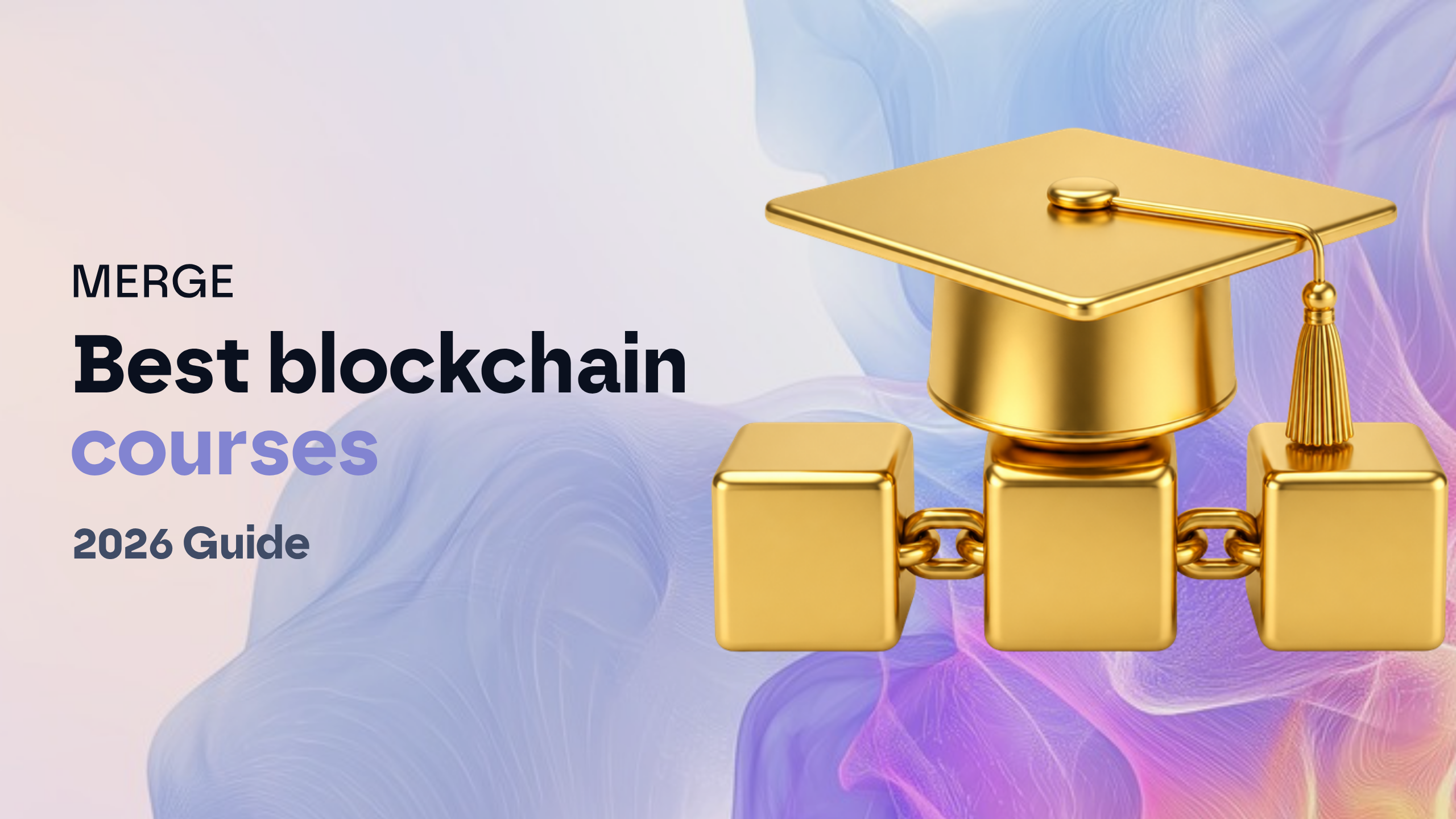

The best blockchain courses in 2026 span free developer tracks like Alchemy University and CryptoZombies, university-backed programs such as MIT Sloan's online short courses, and practitioner-led executive programs like the MERGE Institute × Tritemius Open Program (€1,499, VAT included, 9 modules, 50+ hours of content). The right choice depends on whether you want to code, to lead digital-asset strategy, or to pass a recognized certification. That said, no single course fits everyone: a smart-contract auditor and a bank's head of digital assets need very different curricula, so match the program to your goal before you pay.
This guide evaluates the leading options against consistent criteria, walks through the main course types, and sets out salary data, certification value, and career paths so you can decide which program fits your goals, budget, and experience level.
In 30 seconds
- To code. Alchemy University, Cyfrin Updraft and CryptoZombies are free and very hands-on.
- For enterprise. The Linux Foundation Hyperledger track ($99-299) is the reference.
- To lead digital assets in banking, fintech or compliance. MERGE Institute: 9 modules, 50+ hours, MiCA included and faculty from Santander, Polygon Labs and Kaleido.
- Before you pay. Try for free: MERGE Institute has five free classes delivered to your inbox instantly.
Want to try before you decide? MERGE Institute has five free 30+ minute classes with faculty from Banco Santander, Polygon Labs and Kaleido, sent to your inbox instantly (taught in Spanish). Choose your free class →
1. Why Blockchain Skills Are in High Demand in 2026
The Market Reality: Job Growth and Talent Shortages
Blockchain is no longer a speculative niche. It underpins decentralized finance (DeFi), tokenized real-world assets, enterprise supply chains, and the broader Web3 stack, and that spread of use cases has pulled demand for skilled people well ahead of supply.
The numbers tell the story. In 2025, 66,494 new Web3 roles were posted, up 47% on 2024, though still below the 2022 peak (Coincub). Engineering remains the largest hiring category: 34.1% of the 2,932 active openings in the first half of 2026 were for technical profiles and blockchain developers (Tiger Research). 2026 started slowly, but the third quarter turned it around: on CryptoJobsList, new postings rose 41.5% in July from June and tripled by September (1,241 postings), while applications fell 27%.
The crypto job market in numbers
In the third quarter of 2026, new postings on CryptoJobsList tripled while applications fell 27%.
Demand is concentrated in centralized exchanges and stablecoin and payments companies, which together account for almost half of active openings in the first half of 2026, followed by infrastructure and institutional finance. Regulation is a growth driver in its own right: the implementation of frameworks like MiCA in Europe and the GENIUS Act in the United States (signed in July 2025 and due to take effect by 18 January 2027 at the latest) has created genuinely new compliance-focused job categories. MiCA entered into force in June 2023, has applied in full since 30 December 2024 and, since the transitional period ended on 1 July 2026, only authorized providers (CASPs) can keep operating in the EU. That licensing clarity is one reason institutional participation keeps rising.
The shortage is real at the senior end. Demand is supported by a persistent talent gap, with many employers reporting difficulty hiring senior blockchain engineers, particularly those with production experience in Solidity, Rust, and Go; for new entrants that shortage creates opportunity, but only if you build demonstrable skills in areas where hiring is consistent: security, compliance, and infrastructure.
Blockchain Developer Salary Trends in 2026
Salary estimates vary by source and methodology, which is normal in a field this specialized, but the direction is clear: blockchain pay sits above general software engineering. In the United States, as of October 2026, the average annual pay for a blockchain developer was $111,845 a year, according to ZipRecruiter (median $109,400). Employer-reported datasets run higher: in November 2026, Salary.com put the average at $120,462, with an hourly rate of $58, while Glassdoor puts median total pay at around $139,000-141,000, with the middle half between $111,373 and $177,320 and the top 10% near $218,382 (per KORE1's salary guide).
Entry-level pay is also above the average for junior profiles. As of October 2026, ZipRecruiter put the average pay for a junior blockchain developer in the United States at $88,976 a year. Specialization widens the spread further. Web3-native salary pages show smart contract developers around $125,000 average base, general blockchain developers around $150,000, and architecture-focused roles around $160,000, with ceilings reaching $250,000-275,000 (web3.career, November 2026).
Some skills carry measurable premiums. Profiles with Solidity, Foundry, Hardhat or EVM experience earn 10% to 20% more than generalists at the same level (Haystack, 2026), and mid-level roles that ask for AI have a median of $115,000, 21.1% more than those that do not (CryptoJobsList). The career ladder follows the usual shape: a junior with zero to two years of experience, a mid-level smart-contract developer with three to five years, and lead or principal blockchain engineers with 10+ years in a base range of roughly $210,000 to $280,000, and total compensation of $290,000 to $450,000-plus at token or equity employers, according to KORE1's salary guide.
| Role | Figure (US) | |
|---|---|---|
| ZipRecruiter (Oct 2026) | Blockchain developer | Average $111,845; median $109,400 |
| ZipRecruiter (Oct 2026) | Junior developer | Average $88,976 |
| Salary.com (Nov 2026) | Blockchain developer | Average $120,462 ($58/h) |
| Glassdoor (via Coursera and KORE1, 2026) | Blockchain developer, total pay | Median ~$139,000-141,000 |
| web3.career (Nov 2026) | Smart contracts / architecture | $125,000 / $160,000 (ceilings of $250,000-275,000) |
| KORE1 (Jul 2026) | Lead or principal (10+ years) | Base $210,000-280,000; total $290,000-450,000+ |
| web3.career (Nov 2026) | Web3 developer in Spain | Average ~$45,000 |
What blockchain profiles earn in 2026, by source
Two caveats matter. First, these figures are mostly US-centric; hubs such as London, Dubai, Singapore, and Berlin attract employers because licensing clarity and regulatory frameworks encourage institutional participation, but European and Asia-Pacific base pay generally runs below US levels. Second, some compensation is paid partly in tokens or equity, which fluctuate and can lose value. In Spain, a Web3 developer earns around $45,000 on average (web3.career, November 2026), and a senior smart contract profile around €80,000-120,000; working remotely for international companies pushes those figures higher.
Beyond Development: Blockchain Career Paths in 2026
Blockchain is not only for coders. The sector now hires analysts, strategists, compliance officers, and entrepreneurs: compliance and legal is already the second-largest hiring category, with 10.4% of openings in the first half of 2026, when in 2023 it did not even appear as a category of its own (Tiger Research). Emerging roles include tokenomics designers, DAO governance specialists, and on-chain data analysts, and a new compensation driver has appeared: 53% of Web3 job postings now mention AI skills, up from 23% in early 2025, according to CryptoJobsList's 2026 Web3 Workforce report.
The practical implication is that your course choice should map to a target role. A prospective auditor needs deep Solidity and security work; a bank's product lead needs tokenization, custody, and regulation; a compliance professional needs MiCA and AML fluency more than production coding. We return to this decision framework later.
MERGE Institute
Learn crypto and digital assets from the leaders of the ecosystem
A 12-week programme, taught in Spanish by working professionals. Start with one of our five free classes.
Try a free class →










2. What to Look for in a Blockchain Course
Curriculum Depth and Relevance
Blockchain moves quickly, and a course built on 2018–2020 material will leave you behind. Check that the syllabus covers current protocols and themes: Ethereum and its Layer 2 scaling solutions, Solana, Polkadot, zero-knowledge rollups, and cross-chain development. While Solidity will always be needed in Ethereum development, the growth of chains such as Solana and Polkadot has created vast demand for Rust developers, and dedicated skills in areas such as zero-knowledge proofs or the Cosmos SDK generate even narrower, more specific talent pools.
Prioritize project-based learning over pure theory, and ask how often the material is updated. A strong program states this plainly; MERGE Institute, for example, markets its on-demand content as "+50h of on-demand content, always up to date."
Instructor Credentials and Industry Experience
The clearest red flag is an instructor with no verifiable real-world blockchain experience. Green flags are active contributors to open-source projects, published researchers, and practising developers and operators. Community reputation is checkable on developer forums, LinkedIn, and project repositories. Practitioner faculty is also a selling point worth verifying: the MERGE Institute program, for instance, is taught by active professionals in banking, protocols, regulation, and Web3.
Certification Value and Employer Recognition
Not all certificates carry equal weight. There are platform-issued completion certificates, vendor-specific or foundation-backed credentials (for example from the Linux Foundation for Hyperledger Fabric), and university certificates of completion. For developer roles, hiring managers tend to value a portfolio over a certificate; for enterprise and compliance contexts, a recognized vendor-neutral credential can help clear HR screens. Linux Foundation certifications are a useful benchmark here: they are vendor-neutral, globally recognized, and delivered through self-paced e-learning, instructor-led training, and performance-based exams.
Be precise about terminology. A non-university executive certificate is not an accredited master's degree, and reputable providers say so. MERGE Institute, for instance, issues an Executive Program certificate from MERGE Institute × Tritemius accrediting your training in blockchain, crypto, and digital assets: a professional certificate, not an official university degree. It is awarded in both the Open and the Executive formats, and in the Executive it also mentions the final project.
Hands-On Practice and Portfolio Building
Theory alone does not get you hired. Look for testnets, live coding environments, and capstone projects that leave you with a GitHub-ready portfolio. The best free developer tracks are strong here: Alchemy University's Ethereum Bootcamp teaches the fundamentals of EVM development "from zero to hero," with coding challenges and projects rather than passive video. Mentorship, peer review, and community support structures matter too, because they keep you moving when the material gets hard.
Flexibility, Price, and Support
Decide on format first. Self-paced suits learners balancing a job; cohort-based adds accountability, live sessions, and networking. Compare money-back guarantees, trial periods, and the depth of student support (live Q&A, Discord communities, office hours). The same program can offer both intensities: MERGE Institute's Open Program is 100% self-managed with recorded content at your own pace for one year, while the Executive Program adds a quarterly cohort of up to 30 people, with live sessions every Tuesday from 18:30 to 20:30 CET for 12 weeks, an assigned tutor and a ticket to MERGE Madrid. The next Executive cohort starts on 1 December 2026.
| Open | Executive | |
|---|---|---|
| Price | €1,499 (VAT included) or from €124/month | Ask on the evaluation call |
| Pace | Your own pace, no schedule | 12-week quarterly cohort |
| Content | 50+ h on demand, always up to date | Everything in Open + 24 h of live classes |
| Support | Quizzes and self-assessed practical cases | Assigned tutor and 1-on-1 feedback on your final project |
| Community | MERGE community (Discord and WhatsApp) | Group of up to 30, MERGE Talent and a ticket to MERGE Madrid |
| Start | Anytime, with immediate access | Next cohort: 1 December 2026 |
MERGE Institute: same syllabus and faculty, two intensities
3. Types of Blockchain Courses Available in 2026
Blockchain for Beginners
For complete newcomers, beginner courses cover distributed ledgers, consensus mechanisms, wallets, and basic cryptography, usually in a short, self-paced format. Free introductions are plentiful; for example, Alchemy University's Introduction to Blockchain is a free, 43-lesson beginner course teaching blockchain technology, Web3, DeFi, and the future of the internet. MERGE Institute also offers five free classes of 30+ minutes each, one on fundamentals and four specialized ones, delivered by email instantly.
Blockchain Developer Courses
Aimed at software developers moving into Web3, these cover Solidity, Rust, smart-contract development, and security. A typical structured path runs from fundamentals through Ethereum, smart contracts, developer tooling, DeFi, DAOs, and scalability, the shape of the open-source ConsenSys Academy curriculum, which spans cryptography, consensus, wallets, Solidity, developer tooling, and Layer 2 scaling.
DeFi Courses for Beginners and Intermediates
DeFi courses suit finance professionals and aspiring protocol developers. Entry-level material covers liquidity pools, automated market makers (AMMs), yield strategies, and protocol risk. The institutional reality is more nuanced than the marketing: one MERGE session noted that DeFi yield collapsed from around 12% APY in the 2021 cycle to roughly 4% APY, forcing global institutions to abandon pure crypto strategies and combine approaches. Good DeFi education teaches the risks, not just the returns.
Cryptocurrency Trading Courses
Trading courses target active traders, investors, and portfolio managers, covering technical analysis, on-chain metrics, risk management, and derivatives. Approach this category with particular care: crypto-assets fluctuate and can lose value, and no course should be treated as investment advice or a promise of returns. For the risks involved in trading and holding crypto-assets, see MERGE's risk notice.
Enterprise Blockchain Training
Built for corporate teams, IT managers, consultants, and executives, enterprise training focuses on permissioned platforms such as Hyperledger Fabric, R3 Corda, and Quorum, and is often employer-sponsored and more structured. The Linux Foundation's Hyperledger Fabric: Design, Develop and Deploy (LFS270) is a 25- to 30-hour, self-paced e-learning course that includes multiple hands-on labs.
Smart Contract Training and Auditing Courses
Security specialization is among the most in-demand niches. These courses teach writing, testing, deploying, and auditing smart contracts. Smart contract security auditors command the highest compensation and face a significant shortage of qualified specialists. If you want the clearest route to premium pay, this is it.

The largest conference on crypto and digital assets
Banks, fintechs and the crypto ecosystem at the same table. Two editions in 2027:
4. Comprehensive Comparison Table: Top Blockchain Courses in 2026
The courses below were assessed on curriculum quality, instructor credibility, hands-on practice, certification value, community strength, and value for money. Prices and availability change; always confirm current details on each provider's official page before enrolling. The table opens with MERGE Institute because this guide's business line is institutional, practitioner-led education, then covers widely used alternatives across free and paid tiers.
Comparison Table
| Provider | Level | Duration | Price (Nov 2026) | Certificate | Best for | |
|---|---|---|---|---|---|---|
| Open Program | MERGE Institute × Tritemius | Beginner-Advanced | 50+ h, self-paced, 1-year access | €1,499 (VAT incl.) | Yes, non-university | Finance, legal and tech professionals |
| Ethereum Bootcamp / Intro to Blockchain | Alchemy University | Beginner-Intermediate | Self-paced (91 and 43 lessons) | Free | Portfolio | Developers |
| Solidity, Foundry, security and DeFi | Cyfrin Updraft | Beginner-Advanced | Self-paced, 150+ h | Free | Platform certificates | Aspiring auditors |
| CryptoZombies | CryptoZombies | Beginner | Self-paced | Free | No | First taste of Solidity |
| Bitcoin and Cryptocurrency Technologies | Princeton (Coursera) | Beginner-Intermediate | ~2 weeks at 10 h/week | Free | No | Technical fundamentals |
| Blockchain Specialization | University at Buffalo (Coursera) | Intermediate | 4 courses, ~66 h | Coursera Plus or per course | Yes | Academic learners |
| Blockchain Technologies | MIT Sloan | Intermediate | 6 weeks, 5-8 h/week | $3,850 | Completion | Executives |
| Blockchain and Crypto Applications | MIT Sloan | Intermediate-Advanced | 8 weeks | $3,850 | Completion | Executives and finance profiles |
| LFS270 + HFCP | Linux Foundation | Intermediate-Advanced | 25-30 h + 90-min exam | $99 course; $250 exam; $299 bundle | Yes (HFCP, 2 years) | Enterprise teams |
| Developer Program On-Demand | ConsenSys Academy | Beginner-Intermediate | Self-paced | On request | Yes | Aspiring Ethereum devs |
| Certified Blockchain Expert / Developer | Blockchain Council | Beginner-Intermediate | Self-paced | $349 / $399 (list) | Yes | A quick credential |
| Binance Academy | Binance | Beginner | Self-paced | Free | No | Crypto basics |
The best blockchain courses in 2026. Prices and availability as of November 2026; confirm on each provider's site.
Verified details behind the table: ConsenSys Academy no longer advertises cohorts of its bootcamp (the last one ran in 2021); its current offer is the self-paced Developer Program On-Demand. For MIT, MIT Sloan's "Blockchain Technologies: Business Innovation and Application" runs 6 weeks at 5 to 8 hours a week for $3,850 USD (next start: 20 January 2027), and "Blockchain and Crypto Applications: From Decentralized Finance to Web 3" runs over 8 weeks for $3,850 USD. For enterprise learners, the Hyperledger LFS270 course is $99 on its own, or $299 bundled with the Hyperledger Fabric Certified Practitioner (HFCP) exam. Alchemy University, Cyfrin Updraft, CryptoZombies, and Binance Academy remain free in 2026, while the University at Buffalo specialization on Coursera can no longer be taken for free.
Key Takeaways from the Comparison
For complete beginners on no budget, Alchemy University, Cyfrin Updraft, and CryptoZombies are strong, hands-on free options, while Binance Academy is useful for crypto fundamentals. For career changers and serious developers, an MIT Sloan university short course or a live bootcamp such as Encode Club's adds structure, mentorship, and a recognized certificate. For enterprise teams, the Linux Foundation's Hyperledger track is the reference standard. MERGE Institute stands out for its institutional, practitioner-led angle, linking blockchain, DeFi, tokenization, and regulation (including a dedicated MiCA module) rather than treating code and compliance as separate worlds.
5. Spotlight: MERGE Institute: A Standout in Blockchain Education
Among the paid options, MERGE Institute is worth a closer look for one reason: it is built for the convergence of traditional finance and the digital economy, not for retail trading or generic "learn to code" promises. This is an editorial recommendation grounded in verifiable facts, not a hard sell.
Discover MERGE Institute in 3 minutes
Introduction to the MERGE Institute × Tritemius program (in Spanish).
What Is MERGE Institute?
MERGE Institute is the education business of MERGE, the institutional crypto, blockchain, and Web3 ecosystem connecting Europe and Latin America. The flagship offering is an online executive program with 9 modules in blockchain, DeFi, tokenization, and digital assets. It was built with Tritemius, and its pedagogy is explicitly practitioner-led: a 9-module program taught by active professionals in banking, protocols, regulation, and Web3. Rather than a sprawling MOOC library, it is a structured learning environment that starts from the fundamentals (M0 and M1) through to advanced topics.
| What you learn | Instructor | |
|---|---|---|
| M0-M1 | The new paradigm of money: blockchain, digital assets, tokenization and stablecoins | Paula Pascual, MERGE |
| M2 | Banking, markets and the financial system: custody, tokenized deposits, CBDCs | Ramón Pajaro, Banco Santander |
| M3 | DeFi: lending, staking, DEXs, collateral and on-chain analytics | Xavier Armengol, DeFi mentor |
| M4 | Web3 and business models: stablecoin payments, RWAs, prediction markets | Manuel Echanove, Polygon Labs |
| M5 | Enterprise blockchain: when to use it and when not, public and private networks | Javier García, Kaleido |
| M6 | Infrastructure: consensus, L1 and L2, bridges, oracles and security | Iñigo García de Mata, Sybol |
| M7 | Regulation: MiCA, regulated custody and investor protection | Alfredo Muñoz (UCM) and Lucía Suárez (Santander) |
| M8 | Future of the financial system: tokenization, payments, AI and the agent economy | Luis Pastor, Tritemius |
| M9 | Markets and valuation: price, cycles, tokenomics and white papers | Carlos Fernández and Sacha Gordillo, Tritemius |
The MERGE Institute program, module by module
The wider MERGE ecosystem gives the Institute its context. MERGE runs a conference series, with MERGE Madrid as its Southern European hub and Latin American editions such as MERGE Buenos Aires, and it is Europe's largest crypto and tech event: its Madrid edition in October 2026 drew 3,000+ attendees and 200+ speakers, with participants from 40+ countries. That proximity to banks, regulators, and protocol teams is what keeps the curriculum current, and students get priority access, discounts and in-person meetups at the events.
Why MERGE Institute Ranks Among the Best in 2026
Four points stand out. First, curriculum breadth: nine modules run from foundational concepts to advanced DeFi, tokenization, enterprise blockchain and, since October 2026, crypto-asset markets and valuation. Second, regulatory depth that generic developer courses skip entirely: the program covers MiCA in Module 7 with Alfredo Muñoz (PhD in Law, UCM, and Of Counsel at CECA MAGAN) and Lucía Suárez (Head of Compliance Digital Assets, AI & Payments at Banco Santander). Third, faculty quality, with instructors from Banco Santander, Polygon Labs, Kaleido, Sybol, Tritemius and CECA MAGAN, plus masterclasses from executives at Visa, Ripple, Circle, Kraken, Securitize and Solana Foundation. Fourth, a clearly stated certificate: on completion you receive a MERGE Institute × Tritemius Executive Program certificate.
Program faculty
 Paula PascualMERGEM0-M1
 Ramón PajaroBanco SantanderM2
 Xavier ArmengolDeFiM3
 Manuel EchanovePolygon LabsM4
 Javier GarcíaKaleidoM5
 Iñigo García de MataSybolM6
 Alfredo MuñozUCM · CECA MAGANM7
 Lucía SuárezBanco SantanderM7
 Luis PastorTritemiusM8
 Carlos FernándezTritemiusM9
 Sacha GordilloTritemiusM9
Working professionals. Plus masterclasses with executives from Visa, Ripple, Circle, Kraken, Securitize, dYdX, Mercado Pago and Solana Foundation.
Two honest clarifications. The program is a non-university executive program, not an official master's degree. And while the Executive Program is linked to a talent network (MERGE Talent) that companies consult, that is not a job-placement guarantee; no course can promise employment or a specific salary.
Who Should Consider MERGE Institute?
It fits career changers from traditional finance, law, or technology; crypto-curious professionals who want structured learning rather than scattered tutorials; and managers who need to understand tokenization, custody, and regulation to lead digital-asset projects. Pure protocol engineers chasing a Solidity-only role may prefer a developer bootcamp or a free technical track first, then add the institutional and regulatory layer that programs like MERGE Institute provide.
6. MERGE Institute for Beginners: Your On-Ramp to Blockchain
The Onboarding Experience
MERGE Institute is designed to take newcomers from zero without overwhelming them, which is why the program starts from the fundamentals (M0 and M1) through to advanced topics. The Open Program removes schedule pressure entirely: once you complete payment you have immediate access to the content and start at your own pace. Content is on-demand and accessible online, so you can learn around a full-time job.
Start free: five MERGE Institute classes
30+ minutes each. Pick yours and it lands in your inbox instantly.
- FundamentalsProblems of the current financial system and how blockchain solves themPaula Pascual · MERGEGet this class →
- Banking and digital marketsBanking and digital assets: tokenization of financial instrumentsRamón Pajaro · Banco SantanderGet this class →
- Enterprise blockchainUse cases beyond the financial sectorJavier García · KaleidoGet this class →
- DeFiMain protocols and concepts of decentralized financeXavier Armengol · DeFi mentorGet this class →
- Web3Business models: stablecoins, DeFi and prediction marketsManuel Echanove · Polygon LabsGet this class →
Free MERGE Institute classes (in Spanish).
Foundational Curriculum Overview
Rather than inventing a module list, here is what a well-built foundational track teaches, mapped to the themes MERGE Institute and quality programs cover from the ground up:
- What blockchain is: distributed ledgers, nodes, and consensus, framed as "blockchain as new infrastructure."
- Cryptography fundamentals: hashing, public and private keys, and digital signatures, which underpin every wallet and transaction.
- The dominant networks: how Bitcoin and Ethereum work, and why their design choices differ.
- Wallets, transactions, and gas: the practical, hands-on layer every user and builder needs.
- Introduction to smart contracts: what self-executing on-chain code is and why it matters for finance.
Crucially, each concept connects to real institutional use cases (payments and stablecoins, custody, and tokenization) rather than staying abstract.
Support Structure for New Learners
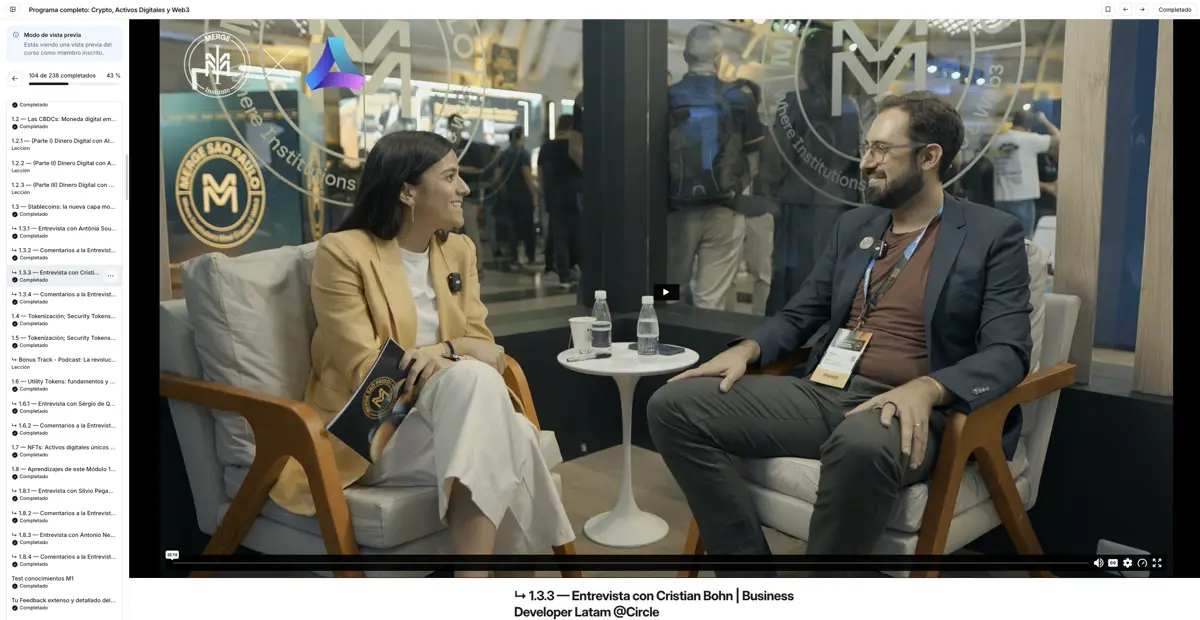
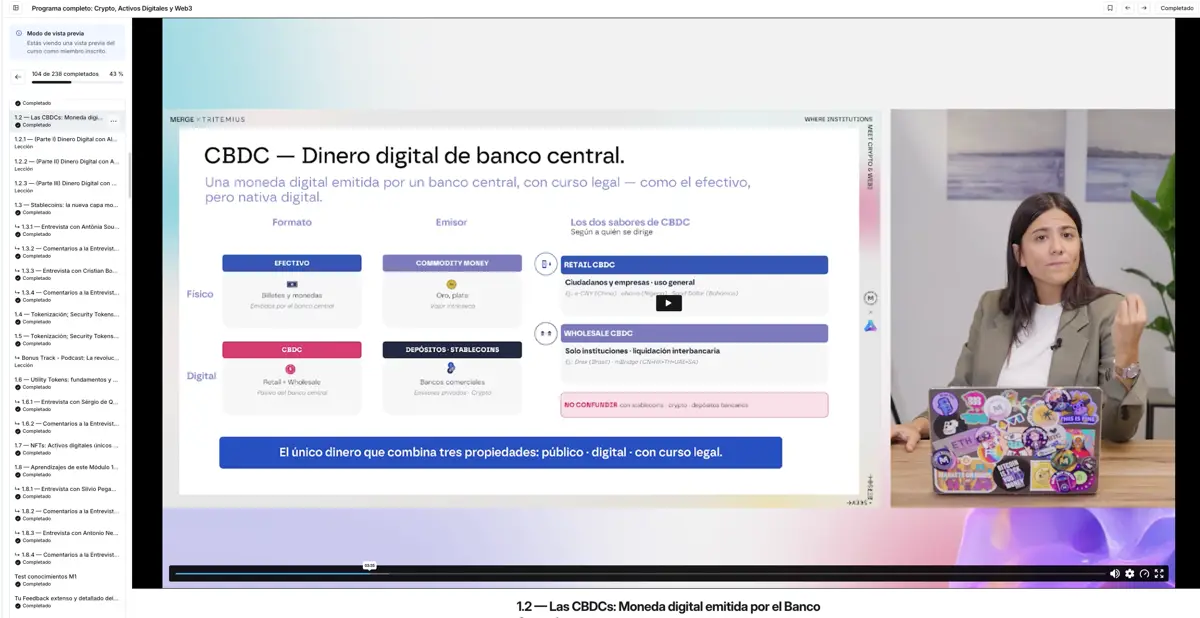
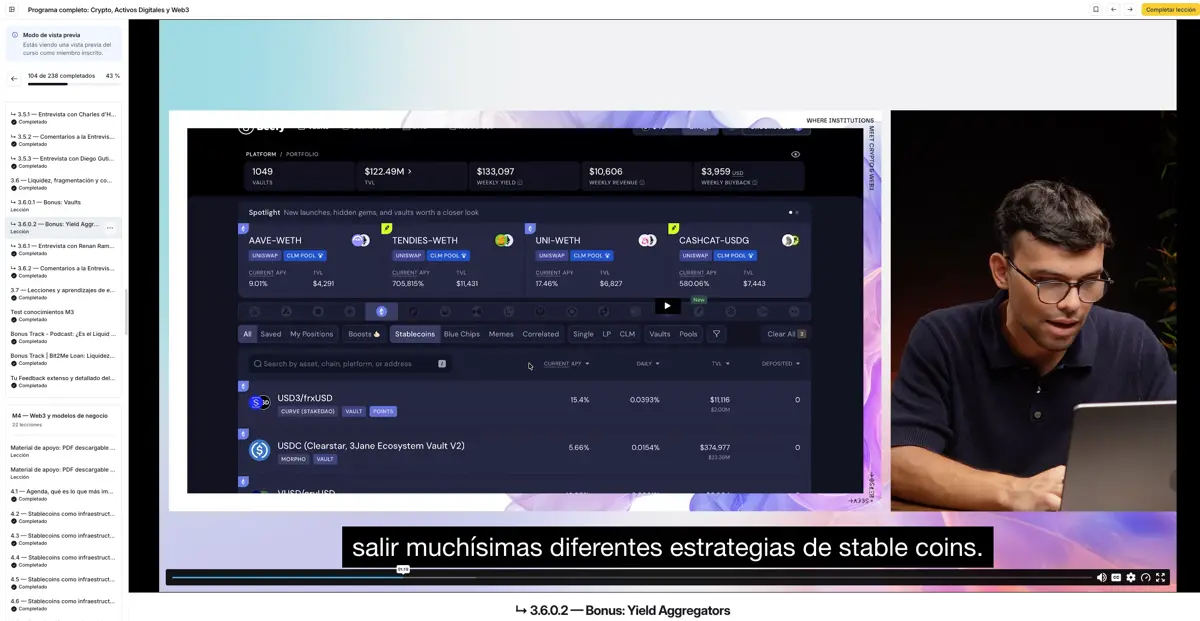
Beginners do best with community and feedback. MERGE Institute includes access to the MERGE community via Discord and WhatsApp, plus quizzes and self-assessed practical cases to check understanding as you go. For time planning, the program is modular: each module is designed to be completed in one to two weeks with three to four hours per week.
Inside the platform
What Beginners Achieve After Completion
A beginner who finishes the foundational modules gains genuine blockchain literacy: the ability to evaluate projects, read a whitepaper critically, navigate a wallet, and speak the language of digital assets with colleagues and clients. You also earn the MERGE Institute × Tritemius certificate and full access for one year from the enrollment date, which gives you room to progress into the more advanced modules at your own speed.
MERGE Institute
Learn crypto and digital assets from the leaders of the ecosystem
A 12-week programme, taught in Spanish by working professionals. Start with one of our five free classes.
Try a free class →7. MERGE Institute for Advanced Learners: Going Deep on Web3
Advanced learners want depth. While MERGE Institute's strength is the institutional and regulatory layer, the infrastructure and development topics below represent what a serious advanced blockchain education should cover in 2026, and where the MERGE ecosystem's content focuses when it goes technical.
Smart Contract Development and Security
Advanced smart-contract work moves from Solidity syntax to production-ready, security-first code. That means understanding common vulnerabilities, reentrancy, integer overflow, and front-running, before you deploy anything. Tooling fluency matters: Hardhat, Foundry, OpenZeppelin, and static analyzers such as Slither. Hands-on practice should include deploying to testnets and simulating attacks in sandboxed environments. Given that smart contract security auditors command the highest compensation amid a significant shortage of qualified specialists, this is the single most valuable advanced specialization to build toward.
DeFi Architecture and Protocol Engineering
Here learners study how DeFi protocols are actually constructed: AMMs on the Uniswap model, lending protocols on the Aave and Compound model, and stablecoin mechanisms. Topics include liquidity provision, impermanent loss, and yield strategy, plus cross-chain interoperability through bridges, wrapped assets, and Layer 2 deployment. The institutional framing is important and is a recurring MERGE theme: as one panel concluded, the belief that crypto asset management should look like crypto is wrong; it will look like traditional asset management. Expect to build by forking a protocol, modifying parameters, deploying, and documenting.
Web3 Infrastructure and Advanced Development
The full Web3 stack covers wallets, nodes, APIs (such as Alchemy and Infura), and indexers (such as The Graph), then dApp construction with frontend libraries like ethers.js and wagmi. NFT infrastructure (ERC-721, ERC-1155, and metadata standards) and DAO tooling (Snapshot, Tally, and Governor contracts) round out the stack. MERGE's own infrastructure coverage reflects where the frontier is: cross-chain interoperability (Wormhole, Axelar, LayerZero), ZK proofs from fundamentals to real-world use cases, account abstraction, and AI × blockchain for data provenance, AI agents, and smart contracts.
Advanced Certifications and Portfolio Outcomes
At the advanced level, a certificate matters less than demonstrable work. Build a GitHub portfolio with mainnet or testnet deployments, documented projects, and, if you pursue security, sample audit reports. At MERGE Institute, Executive participants build a final project with one-on-one feedback from their tutor and present it at a Demo Day, and all students join the MERGE community for peer review and networking. Be wary of any program that promises guaranteed jobs or salary uplift; credible providers, MERGE included, offer skills, a certificate, and a network, not employment guarantees.
8. Core Blockchain Concepts Every Quality Course Should Teach
Use this section as a checklist to evaluate any course, not just MERGE Institute. If a syllabus skips these, it is incomplete.
Distributed Ledger Technology (DLT) Fundamentals
A blockchain differs from a traditional database in that no single party controls it and its history is tamper-evident. Learners should understand the types of distributed ledgers (public, private, consortium, and hybrid), why enterprises adopt them and, above all, when a blockchain does not make sense.
Consensus Mechanisms
Consensus is how a decentralized network agrees on state. A quality course contrasts Proof of Work (PoW) with Proof of Stake (PoS) and explains why Ethereum and others shifted toward PoS, then covers alternatives such as delegated Proof of Stake (DPoS), Proof of Authority (PoA), and Solana's Proof of History (PoH), along with the distinction between Nakamoto and Byzantine Fault Tolerant (BFT) consensus. This directly shapes a chain's trade-offs, as MERGE's own infrastructure content notes: selection should be risk-adjusted, decide what your application can and cannot sacrifice, then pick the chain whose trade-off matches.
Cryptography Essentials
Cryptography is the foundation of blockchain integrity. Expect hash functions (SHA-256, Keccak-256), public-key cryptography (asymmetric encryption, digital signatures, and wallet addresses), and increasingly zero-knowledge proofs (ZKPs), which matter for both privacy and scalability. On the scaling side, Layer 2s scale Ethereum, but optimistic rollups trade slow withdrawal finality for capacity while ZK rollups offer faster, cryptographically settled finality.
Smart Contracts and Programmable Blockchains
Smart contracts are self-executing code deployed on-chain. A good course distinguishes EVM chains (Ethereum, Avalanche, BNB Chain) from non-EVM chains (Solana, Polkadot) and covers use cases across DeFi, NFTs, DAOs, supply chain, and identity. Security is inseparable here: institutions (CFOs, boards, auditors) need clear risk explanation, because nobody will accept liquidation or smart contract risk without understanding it.
Tokenomics and Economic Design
Token standards (ERC-20, ERC-721, ERC-1155, and Solana's SPL), supply mechanics (fixed, inflationary, deflationary, and bonding curves), and incentive design all determine whether a protocol is sustainable. This matters well beyond startups: tokenization of real-world assets is now a core institutional theme, turning bonds, real estate, and funds into digital, liquid, and more accessible financial products.
Blockchain Security Fundamentals
Security splits into on-chain risks (reentrancy, flash-loan attacks, oracle manipulation, and maximal extractable value, or MEV) and off-chain risks (private-key management, phishing, and social engineering). Governance is as important as code: a MERGE custody session stressed that key ceremonies, separation of administrators, operators, multi-signers, and audit trails are non-technical but critical for professional custody. Given the pay premium for auditors, security fundamentals are not optional.
The largest conference on crypto and digital assets
Banks, fintechs and the crypto ecosystem at the same table. Two editions in 2027:
9. Certifications and Career Outcomes: What Credentials Actually Matter in 2026
The Certification Landscape in 2026
The main credentialing bodies include the Blockchain Council, ConsenSys Academy, the Linux Foundation (for Hyperledger), EC-Council (with its C|BP), and university-backed programs. The practical rule: in developer roles, a portfolio usually outweighs a certificate, while in enterprise and compliance contexts a recognized credential helps you clear screening. Vendor-neutral credentials travel well, and the Linux Foundation's are globally recognized.
Top Blockchain Certifications to Pursue in 2026
- Certified Blockchain Developer - Ethereum (CBDE), from Blockchain Training Alliance: a 90-minute online exam with 70 questions, for $275; useful in enterprise and consulting contexts.
- Hyperledger Fabric Certified Practitioner (HFCP), from the Linux Foundation; a 90-minute, online, proctored, multiple-choice exam, with certification valid for two years. The exam alone is $250, or $299 bundled with the LFS270 course.
- Blockchain Council credentials (Certified Blockchain Expert, from $349; Certified Blockchain Developer, $399 list price), recognized by some HR teams. Separately, there is EC-Council's C|BP (Certified Blockchain Professional).
- University certificates, for example, MIT Sloan's online short courses award a certificate of completion from MIT Sloan.
- MERGE Institute × Tritemius certificate, validates training across blockchain, DeFi, tokenization, digital assets, and MiCA; positioned as a non-university executive certificate, not an accredited degree.
Assess each on cost, exam format, renewal requirements, and recognition in your target market before paying.
Building a Blockchain Career: From Course Completion to First Role
Structure your first 90 days around visible output. Build a portfolio with a GitHub profile, deployed contracts, protocol contributions, and, for security, audit write-ups. Find roles on Web3 job boards such as CryptoJobsList, Web3 Career, and Gitcoin, as well as LinkedIn. Network through DAOs, Discord communities, ETHGlobal hackathons and industry conferences. On employment type, remote work remains very common: around 40% of crypto openings in the first half of 2026 were fully remote (Tiger Research). Freelance work can build a track record quickly, while full-time roles offer stability and deeper team learning.
Blockchain Career Paths by Specialisation
Different specializations reward different courses and credentials:
- Smart-contract / security auditor: the highest-paid, shortage-driven niche; prioritize Solidity depth, Foundry, and audit practice.
- Protocol / DeFi engineer: deep EVM and protocol-architecture knowledge; developer bootcamps plus hands-on protocol forks.
- Enterprise blockchain engineer: Hyperledger Fabric and permissioned systems; the Linux Foundation track fits here, and enterprise Hyperledger Fabric roles show stable institutional demand.
- Compliance and risk specialist: MiCA, AML, and KYC fluency; a regulation-heavy program like MERGE Institute suits this path, since compliance and legal is already the sector's second-largest hiring category (10.4% of openings in the first half of 2026).
- On-chain data analyst / tokenomics designer: analytics, token-standard knowledge, and economic design.
- Product and strategy lead: cross-functional understanding of tokenization, custody, and regulation rather than production coding.
One future-proofing note: 2026 has introduced a genuinely new compensation driver, AI fluency, as autonomous AI agents increasingly interact with decentralized systems, so pairing blockchain with AI skills is increasingly valuable across every path.
Key Takeaways
- Demand recovered in 2025 (66,494 new Web3 roles, up 47%) and, after a slow first half, rebounded in the third quarter of 2026, with the sharpest shortages in security, compliance, and infrastructure.
- Pay sits above general software engineering: US averages run from about $111,845 (ZipRecruiter) to around $139,000-141,000 (Glassdoor), with specialization and token or equity components pushing senior comp higher, though those components fluctuate and can lose value.
- Choose by goal and format: free developer tracks (Alchemy University, Cyfrin Updraft, CryptoZombies) for hands-on beginners; university short courses (MIT Sloan) or live bootcamps for career changers; the Linux Foundation track for enterprise; and MERGE Institute for institutional, regulation-aware training.
- Verify credentials before paying: portfolios outweigh certificates in developer roles, while recognized credentials help in enterprise and compliance settings.
- MERGE Institute offers a non-university executive certificate with 50+ hours of on-demand content, one-year access, a dedicated MiCA module, practitioner faculty and five free classes to try before you enroll.
If you want a structured, practitioner-led path that connects blockchain, DeFi, tokenization, and regulation, the MERGE Institute program page is the natural next step.
FAQ
What is the best blockchain course for beginners in 2026?
For hands-on beginners on a budget, free tracks like Alchemy University and CryptoZombies are excellent starting points, and Alchemy University's Introduction to Blockchain is built for high school and up, covering blockchain, Web3, DeFi, and the future of the internet. If you want structured, institutional learning with a certificate, a program such as MERGE Institute's Open Program starts from the fundamentals and runs through to advanced topics at your own pace. You can also start with one of the free MERGE Institute classes.
Are free blockchain courses good enough to get a job?
They can be, especially for developers. Several free platforms in 2026 consistently produce developers and analysts with deployable skills rather than certificate-holders who cannot write a deployment script. The trade-off is that free courses may lack graded assignments, live mentorship, or accredited certificates. Most successful entrants combine free technical practice with a strong portfolio, and add a paid credential when targeting enterprise or compliance roles.
How much do blockchain developers earn in 2026?
Estimates vary by source. ZipRecruiter put the US average at $111,845 a year as of October 2026, while Glassdoor puts median total pay at around $139,000-141,000, with the top tenth near $218,382 (per KORE1). Specialization pays more: architecture-focused roles average around $160,000 base with ceilings up to $275,000. Keep in mind some compensation is paid in tokens or equity, which fluctuate and can lose value.
Is a blockchain certificate the same as a university master's degree?
No. Platform and executive certificates validate training and skills but are not accredited university degrees. MERGE Institute programs, for example, are non-university executive programs that award an Executive Program certificate from MERGE Institute × Tritemius, not an official master's. University short courses such as MIT Sloan's award a certificate of completion, which is also distinct from a degree.
Which blockchain specialization is most in demand in 2026?
Security is the clearest high-demand, high-pay niche: smart contract security auditors command the highest compensation and face a significant shortage of qualified specialists. Compliance is also expanding fast: compliance and legal is already the sector's second-largest hiring category, with 10.4% of openings in the first half of 2026. And AI skills are an emerging premium: 53% of Web3 job postings now mention them.
Does MERGE Institute guarantee a job after I complete the program?
No reputable program guarantees employment, and MERGE Institute does not promise jobs or a specific salary. It provides a non-university certificate, 50+ hours of practitioner-led content, and access to the MERGE community, and the Executive Program is linked to a talent network that companies consult, a network, not a placement guarantee. Your outcomes still depend on your portfolio, skills, and job search.